
How to Value a Childcare Centre Before Buying: The Buyer’s Pre-Offer Process
Most first-time childcare buyers anchor on the asking price. The information memorandum lands in the inbox, the headline number sits next to a photo of a tidy playground, and the buyer either thinks “that’s about right” or “that’s a stretch” — and starts negotiating from there. That is the wrong starting point. The asking price is the seller’s number, built from the seller’s expectations. Your number — what the centre is actually worth to you, on your financing, with your assumptions — has to be built before you make an offer, not during the back-and-forth that follows.
The good news is that the pre-offer valuation work is not complicated. It is four steps, takes a couple of hours, and gives you the spine of an offer that you can defend to your bank, your accountant, and yourself. Here is the process we walk buyers through.
Step 1: Run a Quick Estimate Before You Call the Agent
Before you ring the listing agent, before you ask for the IM, before you book a site visit — put rough numbers into a calculator. The point is not to land on a perfect figure. The point is to know whether the asking price is plausible before you spend 30 hours on a deal that will not stack up.
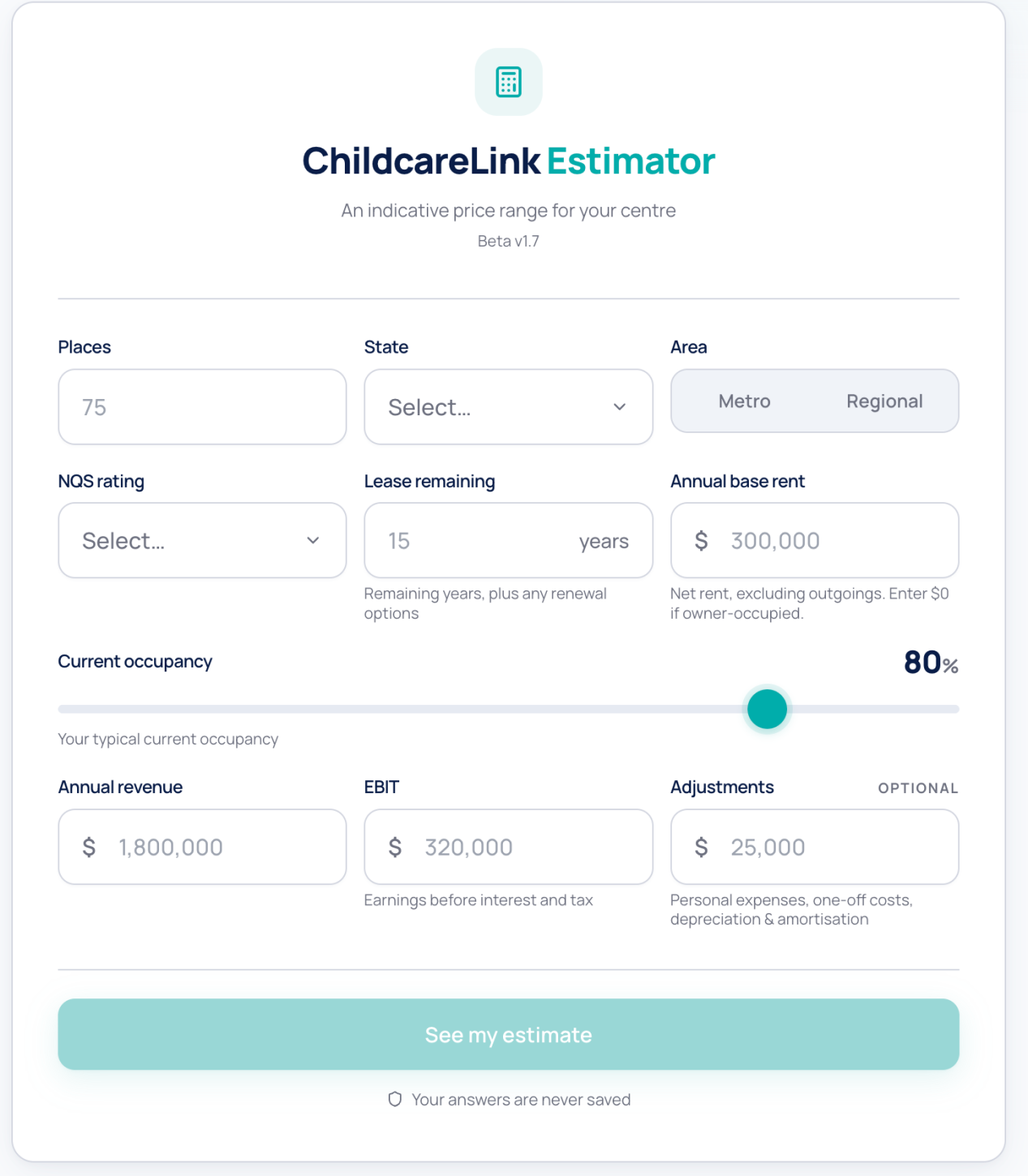
Our free childcare centre value estimator takes about 60 seconds. You enter capacity, occupancy, location, and a few financial inputs, and it returns a market-anchored ballpark range built on current 2025–2026 transaction evidence. Run it on the listing’s headline numbers first. Then run it again on the numbers you would use after stripping the optimism out (we get to that in Step 2). The gap between those two outputs is usually the first honest signal of whether the asking price is reasonable.
ChildcareLink Insight: Roughly half the deals we look at on behalf of buyers fail this first test alone. The asking price is so far above an evidence-based ballpark that the rest of the work is not worth doing — and the buyer can walk away before paying for an accountant’s review or a building report. |
Step 2: Stress-Test the EBITDA in the IM
The EBITDA number on the front page of the information memorandum is almost never the number a buyer should multiply. Owner salaries are often understated, market rent is sometimes understated, one-off maintenance is excluded, and CCS income may include catch-up amounts that won’t repeat. The headline number and the adjusted number can differ by 20–40%.
Before you offer, you have to do the buyer-side adjustments yourself. The detailed mechanics are in our EBITDA adjustments guide; the short version for a pre-offer pass is:
- Replace the owner salary with a market-rate director’s salary for the hours actually worked.
- Add an above-market rent gap if the lease is below market — a buyer’s rent will reset on the next review.
- Strip out one-off items: legal, capital works, COVID-era grants, lumpy CCS catch-ups.
- Annualise occupancy if the most recent quarter is materially different from the trailing twelve months.
Run the estimator a second time on the adjusted EBITDA. That is the number you should be multiplying.
Step 3: Test the Lease or Freehold Assumption
Lease terms drive value more than most first-time buyers expect. A leasehold centre on a 10-year lease with two five-year options trades very differently to one with three years left and no option. A freehold deal is priced on a yield, not on a multiple, and that yield is highly sensitive to lease structure if the property is leased back to an operator.
Australian childcare leasehold transactions typically clear in a 3–5x adjusted EBITDA band, with strong centres at the upper end and weaker lease profiles compressed toward 3x (Benchmark Business Sales, 2025). Freehold yields in metropolitan markets sat in a 4.25–5.25% band over 2025, with regional centres in 5.25–6.25% (Stonebridge Property Group Childcare Investment Review 2025). The detail on lease drivers is covered in our childcare lease explained pillar; for the pre-offer pass, the questions you need answered before you put a number on the centre are:
- How many years are left on the current term, and what option periods follow?
- How is rent reviewed — CPI, fixed, or to market?
- What are the make-good obligations, and who carries the outgoings?
If any of these answers materially weaken the centre’s lease profile, your offer should reflect that — not the seller’s expectation that the lease is “fine”.
Step 4: Build an Offer Band, Not an Offer Number
The single biggest pre-offer mistake we see is buyers turning up with one number. They have decided the centre is “worth $X” and they offer $X. There is no room to move, no defensible logic to step up, and no walk-away point if the seller pushes.
A defensible offer is a band: a low end, a target, and a walk-away ceiling. Each is anchored to a different assumption. The low end uses your most conservative EBITDA adjustments and a 3x multiple (or the bottom of the regional yield band for freehold). The target uses your base-case adjusted EBITDA and a market-evidence multiple. The walk-away ceiling is the highest number your bank will fund — bank valuations on stretched leasehold deals can land 10–15% below contract (Green Finance Group), and most lenders want adjusted EBITDA to cover proposed interest at least twice over with occupancy at 80% or higher at settlement. Your offer cannot exceed what your finance will support, even if your heart says it is the right centre.
For the deeper buyer process around due diligence and financing, see our due diligence checklist, reading childcare financial statements, and the Cluster 2 pillar — how to buy a childcare centre.
Key Takeaway
Run the estimate before you call the agent, adjust the EBITDA before you multiply it, test the lease before you assume it is fine, and offer a band rather than a number. Do those four things and you will negotiate from evidence — not from the seller’s expectation.
Looking at a centre and not sure where to start? Run the free 60-second estimator first, then talk to ChildcareLink for an independent buyer-side review of the IM. Visit childcarelink.com.au or contact our specialist team directly.
Sources
- Stonebridge Property Group Childcare Investment Review (2025); Burgess Rawson / CBRE Childcare Insights FY24–25; Benchmark Business Sales — childcare valuation guidance (2025); Mollard Advisory; Hinge Education Advisors; Colliers Childcare Valuation; Green Finance Group — childcare lending criteria (2025–26); ChildcareLink transaction and advisory experience.
Disclaimer: The information provided in this article is for general informational purposes only and does not constitute financial, legal, or professional advice. ChildcareLink recommends seeking independent professional advice tailored to your specific circumstances before making any business or investment decisions.