
How to Improve Your NQF Rating (And Why It Matters for Centre Value)
Two freeholds. Same suburb, same building footprint, same headline rent of $300,000. One trades on a 4.65% cap rate. The other trades on 5.10%. That is a $570,000 gap on identical-looking real estate, and the cleanest single explanation for it is the rating of the operator running the centre. The buyer market reads the NQF rating as a covenant signal, not a regulator’s tick.
Most operators treat the National Quality Framework rating as a compliance event. The commercial reality is closer to the opposite. A rating is a brand asset that compounds — into enrolment demand, into bank lending appetite, into the multiple a buyer is willing to pay, and into the cap rate a freehold investor will accept. Working on the rating is one of the few activities that simultaneously lifts revenue, reduces risk, and increases sale price.
This article sets out where the rating actually sits commercially, the five practical levers that move it, and the 12–18 month timeline operators actually use to push from Meeting to Exceeding — or, where the starting point is harder, from Working Towards to Meeting.
Where the Rating Sits Commercially
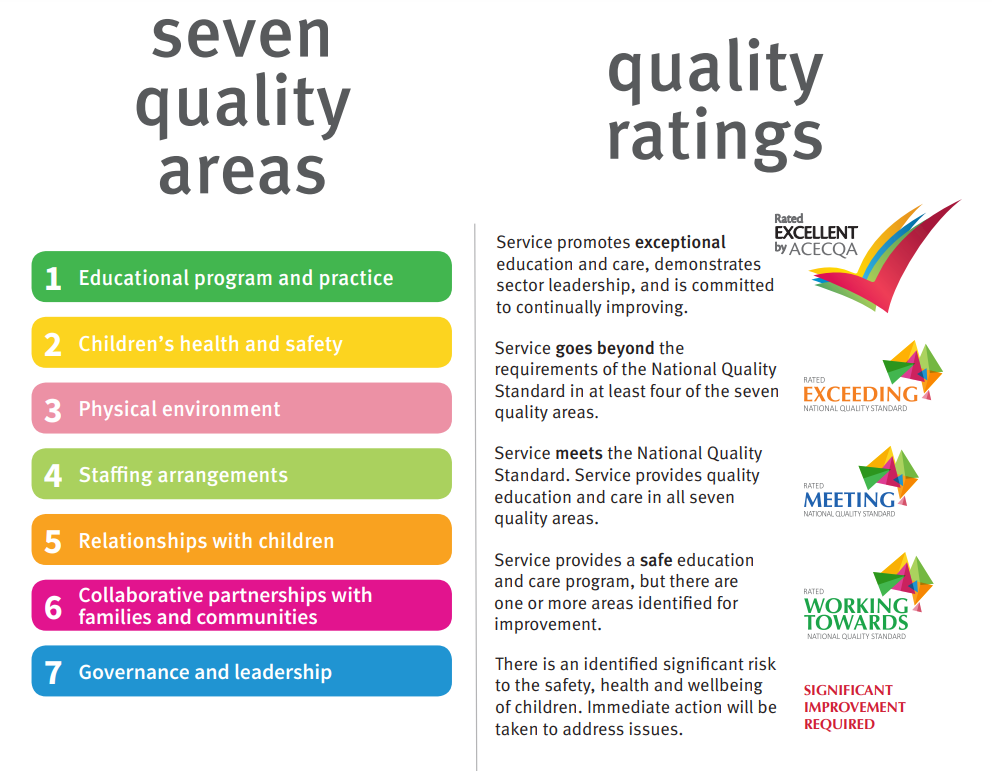
Australia’s centre-based services are rated against the seven Quality Areas of the National Quality Standard, with the four rating levels being Working Towards NQS, Meeting NQS, Exceeding NQS, and (by separate application) Excellent. For the regulator-mechanics of what happens during an assessment and rating visit — who turns up, what evidence they gather, the draft-report window — see our full guide on what happens during an ACECQA assessment and rating visit. What follows is the commercial layer that operators rarely think about until they sit down with a broker.
According to the ACECQA NQF Annual Performance Report 2025, around 92% of centre-based services are rated Meeting NQS or above, with roughly 29% at Exceeding NQS. Working Towards still applies to a meaningful single-digit share of services. Excellent is held by a very small fraction of centres in the country. That distribution matters because the buyer market does not value the ratings linearly. Meeting is the floor of acceptability. Exceeding is the threshold for the broadest buyer pool. Excellent is rare enough that it can underwrite a top-of-market price.
ChildcareLink Insight: The rating gap that costs operators the most money is not Meeting versus Exceeding. It is Working Towards versus everything else. A Working Towards rating shrinks the buyer pool, restricts bank LVR (Loan-to-Value Ratio), and adds 30–60 basis points to the freehold cap rate. Across our 2024–2026 transactions, deals on Working Towards centres took longer to close and required heavier vendor concession to clear. |
Five Practical Levers That Actually Move a Rating
Sector-wide ACECQA data and our own assessment-and-rating debriefs with operators consistently point to two Quality Areas as the most common shortfall: QA1 (Educational program and practice) and QA7 (Governance and leadership). Below is the five-lever framework we walk operators through when the goal is to lift the rating inside an 18-month window.
Lever 1 — Document the practice you already do
The single most common cause of a Meeting rating where Exceeding was warranted is not weak practice. It is weak documentation of strong practice. An authorised officer gathers evidence from observation, discussion with educators, and sighting of documentation. Anything that lives only in an experienced educator’s head is, in the eyes of a rating, practice that did not happen. The first lever is unglamorous and is almost always the highest-return: documented learning stories, planning cycles, family input records, reflective journals, programming evidence linked to learning outcomes. Most centres can lift visible evidence by a full level in three months without changing what they actually do.
Lever 2 — Strengthen QA1 (the educational program)
QA1 is the most frequently underweighted area in the sector. Lifting QA1 is not about fancy curriculum. It is about visibly linking the planning cycle (observe → plan → implement → reflect) to each child’s learning outcomes, evidencing family input into program decisions, and demonstrating that the educators can talk fluently about why a particular experience is offered to a particular child on a particular day. Practical moves: dedicate weekly programming time off-the-floor, build a simple planning template every educator uses, and run monthly reflection meetings minute-by-minute.
Lever 3 — Fix QA7 (governance and leadership) early
QA7 is the second-most-common drag, and the easiest to fix because it is structural. The four practical fixes are a written and current induction process, a clear leadership and decision-making structure on paper, a working continuous improvement plan (the QIP) that is actually used (not laminated), and complaint and grievance processes that are documented in a register. Almost every centre we have walked through a rating lift has done this before anything else, because QA7 evidence is the cheapest evidence to produce and the most visible to an assessor.
Lever 4 — Use the new NQS child-safety standards as an opportunity
The NQS revisions that took effect 1 September 2025 (including the integration of the National Principles for Child Safe Organisations) and 1 January 2026 changed how QA2 (Children’s health and safety) and QA7 are assessed. A standing child-safety lens is now part of how the entire NQF is read. Rather than treat this as one more compliance item, operators who are aiming for Exceeding use the revisions as an opportunity to upgrade documented practice in both QA2 and QA7 at once: child-safe policy refresh, staff recruitment and screening protocols, child voice mechanisms, and the documented escalation pathway for any concern. This is a sector-wide reset that has not yet been priced into many centres’ rating histories — the next assessment cycle is the window.
Lever 5 — Stabilise QA4 (staffing) at the educator-individual level
QA4 (Staffing arrangements) is where the educator shortage shows up in the rating. A centre with high casual usage or repeated under-ratio episodes will be rated Working Towards on QA4 even if every other area is solid — and one Working Towards in any of the seven areas pulls the overall rating down. The practical lever is stability of the educators, not just headcount. Permanent contracts, documented professional development plans for every educator on the floor, and a clear succession plan for room leaders all sit in QA4 evidence. For the underlying sector context driving this lever, see our analysis of the educator shortage crisis, and for the compliance floor see our guide to staff-to-child ratios in Australian childcare.
ChildcareLink Insight: Rating improvement work compounds. Once a centre has documentation discipline embedded — Lever 1 — the same evidence base improves QA1, QA2, QA7 and QA4 simultaneously. The first three months of rating-lift work look like overhead. The next 12 months look like the rest of the business getting easier. |
What Buyers, Valuers, and Banks Actually Do With the Rating
Three audiences read the rating commercially, and each reads it differently.
Buyers read it as a covenant signal. A buyer underwriting a centre at $1.5M revenue and adjusted EBITDA of $260,000 on an Exceeding rating will typically pay closer to the upper end of the multiple range published by Benchmark Business Sales and Hinge Early Education Advisors — around 4.0–5.0x on a single-site quality centre. The same financials on a Working Towards rating will more commonly be modelled at 3.0–3.5x. On a $260,000 EBITDA, that is a $130,000–$520,000 spread on the business sale alone, separate from any rating effect on the freehold.
Freehold investors and valuers read the rating as a cap rate input. A long lease to an Exceeding operator with a clean rating history reduces the perceived re-leasing risk at lease expiry. Across our 2024–2026 transactions, the spread we see between a comparable freehold leased to an Exceeding operator versus a Meeting operator is in the order of 30–60 basis points. Against the metro 4.25–5.25% cap rate band from Stonebridge’s 2025 review, that 30–60 bps moves the freehold price meaningfully — the $570,000 spread in the opening hook is built on a 45 bps gap on a $300,000-rent freehold. A Working Towards covenant compounds the gap further.
Banks read the rating as an LVR (Loan-to-Value Ratio) input. Specialist childcare lenders look at the centre’s full file — occupancy, rating, lease term, financials — and the rating is one of the early gates. An Exceeding rating sits inside the comfort zone for a 65–70% freehold LVR. A Working Towards rating starts pulling LVR back, lifts the buyer’s deposit requirement, and sometimes pushes the buyer toward a higher-cost specialist lender. That changes who can bid, which is the same as changing the price.
The 12–18 Month Timeline
For an operator deliberately working toward a rating lift, the timeline that consistently delivers across our portfolio of advisory engagements looks like this.
Months 0–3 — Documentation discipline. Lever 1 across all rooms. Programming templates, learning stories, family input records, and a centre-wide evidence library that any educator can find and any visitor can sight.
Months 3–9 — QA1 and QA7 lift. Programming cycle visibly running, leadership structure on paper, working QIP that is being used in monthly leadership meetings, induction and complaints registers operational. Internal mock-rating using the published NQS rubric.
Months 9–15 — QA2 and QA4 stabilisation. Child-safety standards refresh embedded, casual usage trending down, professional development plans current for every educator, room leader succession documented.
Months 15–18 — Pre-assessment readiness. Evidence audit, leadership debrief, mock visit, gap closure. Notify the regulator that the centre is ready to be re-rated.
The other commercial dividend of this timeline is that it lines up with the typical 12–18 month pre-sale preparation window. An operator who is improving the rating from a Meeting start in month 0 toward an Exceeding outcome by month 18 is doing the same work that maximises sale price — which is why a centre that is genuinely working on its rating is also a centre that is getting itself ready to sell, whether or not a sale is yet on the table.
The rating, occupancy, and revenue chain also matters here. Occupancy responds to rating because parents read the rating when choosing a centre. The rating lift therefore tends to lift mid-term enrolment, which lifts revenue, which lifts EBITDA, which compounds with the multiple uplift. The operator who does the rating work properly is, in effect, paid twice for the same effort.
Key Takeaway
The NQF rating is the most under-priced commercial asset on a childcare centre’s balance sheet. A deliberate 12–18 month improvement program — documentation discipline, QA1 and QA7 lift, child-safety refresh, QA4 stabilisation — typically moves a centre by a rating level and pays for itself many times over through stronger occupancy, stronger lending appetite, a broader buyer pool, a higher business multiple, and a tighter freehold cap rate. The work is unglamorous. The commercial outcome is not.
Thinking about selling your childcare centre in the next 12–18 months? Knowing what your rating is worth in dollars before you start the lift program is the single most useful number to have on the table. Talk to ChildcareLink for a confidential pre-sale appraisal, or try our childcare centre value estimator for a 60-second indicative read. Visit childcarelink.com.au or contact our team directly.
Sources
- ACECQA NQF Annual Performance Report 2025 — national rating distribution and Quality Area shortfall data
- ACECQA Guide to the National Quality Framework — four rating levels and the seven Quality Areas
- ACECQA National Quality Standard Revisions — child safety standards effective 1 September 2025 and 1 January 2026
- Stonebridge Property Group Childcare Investment Review 2025 — $205M / 27 transactions, metro freehold cap rates 4.25–5.25%, regional 5.25–6.25%, 90–130 bps yield compression
- Benchmark Business Sales and Hinge Early Education Advisors — EBITDA multiple bands 3.0–5.0x leasehold, ~4.0x quality single-site
- ChildcareLink transaction and operator advisory experience, 2024–2026 — rating-to-cap-rate spread observations, buyer-pool depth, bank LVR sensitivity, QA1 and QA7 as priority fix areas
Disclaimer: The information provided in this article is for general informational purposes only and does not constitute financial, legal, or professional advice. ChildcareLink recommends seeking independent professional advice tailored to your specific circumstances before making any business or investment decisions.