
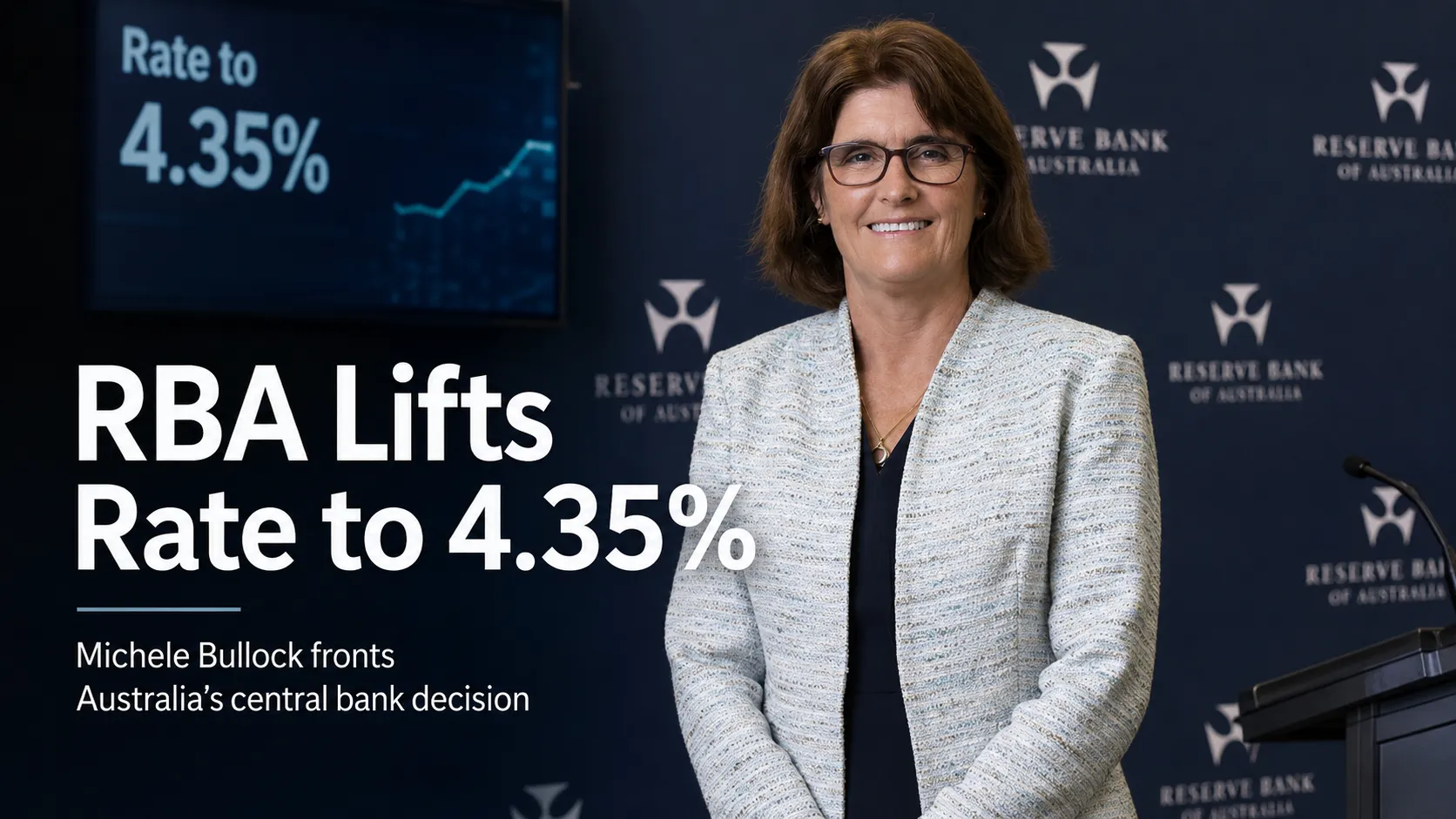
RBA Lifts Cash Rate to 4.35%: What the Third 2026 Hike Means for Childcare Operators
The Reserve Bank lifted the cash rate by 25 basis points to 4.35% on 5 May 2026 — its third hike this year, on an 8–1 majority vote. The cumulative move through 2026 is now 75 basis points, from 4.10% in January to 4.35% today, and the RBA’s accompanying Statement on Monetary Policy flagged that capacity pressures and Middle East commodity inflation are expected to push headline CPI to a peak near 4.8% in June.
For childcare operators, this is the cycle where the lending environment, the wage line, and the rent line all tighten in the same quarter. Below is what the move actually does to an operator P&L, the band the major economists are calling for the rest of the year, and the four moves we’d run through with a centre owner this quarter.
What Changed on 5 May
The decision itself was a 25 basis-point lift to 4.35%, with one dissenter on the Board favouring a hold. The RBA’s reasoning leaned on two pressures: domestic capacity tightness — the labour market and services inflation refusing to soften — and imported commodity inflation flowing through from the Middle East energy market. Headline CPI on the latest ABS print is running ahead of forecast, and the Bank’s own modelling now puts the inflation peak around 4.8% in the June quarter before the disinflation path resumes.
The major-bank economist read is split. CBA’s house view is that 4.35% will hold and that the Board will pause through the rest of 2026. Westpac’s published forecast sits at the other end — two further hikes pencilled in, one at the June meeting and one in August, taking terminal at 4.85%. Both views are live. The takeaway for an operator is not which forecast wins; it is that the floor is no longer 4.10%, and the planning case for the rest of FY26 should not assume relief inside the next two quarters.
The Three Lines of Your P&L That Tighten This Quarter
For an operator, the cash rate flows into the centre through three lines, not one. We covered the broader rate transmission in How Interest Rates Affect the Childcare Property Market — the three-channel framework in that piece (borrowing cost, discount rate, tenant demand) is the property-investor read. Operators sit downstream of all three, but the way the move shows up in your monthly P&L is more concentrated.
Line 1 — The commercial mortgage and any leasehold business loan
Major-bank commercial mortgage rates for childcare freehold are now broadly in the 6.50–8.75% range, with specialist non-bank lenders pricing wider — roughly 5.5% to 13% depending on covenant, structure, and capital stack. Working-capital lines and overdrafts have repriced in step. The full structure of how this stack is built is in our financing childcare centre purchase guide; the practical point on a hike is that a variable commercial mortgage written off the BBSW or the bank’s reference rate will reprice within a billing cycle of the RBA’s decision. Fixed positions written before January 2026 are still on the old curve, but every fixed rolls eventually.
ChildcareLink Insight: On a $1.5M operator commercial loan, every 25 basis points adds roughly $3,750 a year in interest cost. On a $3M loan it’s about $7,500. The 75 basis points 2026 has already delivered means the same operator is carrying $11,250 to $22,500 a year more in interest, before any further hike. That number lands directly under EBITDA — it doesn’t get recovered through fees in the short cycle. |
Line 2 — Working-capital and equipment finance
This is the line most operators forget when they price the cycle. Overdraft facilities, equipment leases, vehicle finance, and any short-term working capital line written variable have all repriced through 2026 at roughly the same trajectory as the cash rate. For a centre with a six-figure overdraft facility used to bridge CCS reconciliation timing or fortnightly payroll, 75 basis points of cumulative 2026 tightening compounds against an already-stretched cash conversion cycle. The Department of Education’s CCS quarterly run-rate keeps the revenue base stable, but timing of payments doesn’t move with rates — the cost of carrying that timing gap does.
Line 3 — The lease line, through CPI compounding
This is the line that operators on a CPI-linked rent review are watching most closely right now. With CPI heading toward 4.8% in the June quarter on the RBA’s own forecast, any centre on a CPI rent review that lands in the next two quarters faces a bigger compounding base than the standard 2.5–3.5% planning case. Over the course of a 10–15 year lease, two consecutive CPI reviews at high-4s materially shift the rent-to-revenue ratio. The mechanics — and how the review structure interacts with the cycle — sit in Rent Reviews in Childcare Leases: CPI vs Fixed vs Market. The pillar lease guide is in Childcare Centre Lease Explained; outgoings allocation, which behaves differently to base rent in a tightening cycle, is broken down in Outgoings in Childcare Leases: Who Pays What?.
ChildcareLink Insight: Three lines tightening at once is a pattern we last saw in 2022–2023. The operators who came through that cycle without distress all had one thing in common: they ran a line-by-line scenario the same week the RBA moved, and they made the structural call (refinance / lease re-cut / fee cycle / staffing shape) inside the next quarter — not at year-end. The cycle penalises waiting more than it penalises acting. |
What This Sits On Top Of
The rate move is not arriving into a quiet P&L. The wage line is already moving from the Fair Work Commission’s Children’s Services Award restructure that took effect 1 March 2026 — the Gender-based Undervaluation determination has rebuilt the classification structure and is staged through to 2028/29. The Worker Retention Payment lifted to 15% above award from December 2025. Insurance has been hardening for two years on the ICA’s commentary. And family disposable income — the input to gap-fee tolerance and Friday session retention — is being squeezed by the same mortgage repricing happening on the operator side. The full operator cost stack is laid out in Childcare Centre Operating Costs Breakdown.
The simple read: the rate hike is one input into a P&L that was already absorbing three other current-cycle pressures. Each one is manageable on its own. The combination is what stress-tests the cash buffer.
Four Moves to Run This Quarter
These are the four conversations we’d have with a centre owner inside the next 30 days.
1. Refinance review — variable vs fixed, lock window, covenant test.
If you’re variable and your facility rolls in the next 12 months, run the comparison now: what would a 2- or 3-year fixed cost today, and where does it land if Westpac is right and another 50 basis points come through. The decision isn’t about predicting the curve — it’s about whether your business can absorb terminal at 4.85% and still service the loan with margin. If the answer is no, the lock decision is a covenant decision, not a rate-call decision. Your interest-cover ratio (ICR) is the gate the bank watches; a refinance review now also gives you visibility into whether your existing covenants are tight at 4.35% or only tight at 4.85%.
2. Fee cycle calendar timed to enrolment communications.
Most centres run their annual fee review through the second half of the calendar year for a 1 January effective date. With CPI peaking in June and the wage line already moving, the planning case for that fee review needs to be set now, not in October. The communication cycle to families — newsletter sequence, individual-fee letters, gap-fee position statement — should be built around the message you want them to hear before the cost-of-living conversation gets harder in spring. Centres that get this rhythm right protect occupancy through the review; centres that don’t lose Friday sessions first.
3. Working-capital headroom test — three-month cost coverage.
Pull your last six months of payroll, CCS reconciliation timing, supplier payment terms, and outgoings invoices, and stress-test whether you have three months of cost coverage available between cash and committed working-capital lines. If you don’t, this is the quarter to extend the facility, not next quarter. Bank credit appetite is still open for childcare — we’re seeing lender behaviour through 2026 that says they’ll back operating childcare with clean financials and a steady occupancy print — but it tightens at the margin in a hiking cycle. Asking for headroom early is cheaper than asking for it under pressure.
4. Lease renewal timing — bring forward if your review window sits in the next 18 months.
If you have a rent review or an option exercise in the next 18 months, the planning conversation belongs in this quarter, not in the month before the review date. Two scenarios drive the timing decision: a CPI review landing into a high-4s print sets the compounding base much higher than a market review or a negotiated fixed; an option exercise in a tightening cycle is leverage if the landlord is also under finance pressure. Either way, the negotiation is stronger if it’s run when the operator has time, not when the date is on top of them.
The Bottom Line
The 5 May 2026 decision moved the cash rate to 4.35%. For a childcare operator, that’s another $3,750 to $7,500 per year per million of loan, on top of a wage-line restructure and a CPI peak forecast at 4.8%. The headline rate is one number; the operating impact is the combination of mortgage line, working-capital line, and lease line tightening together. The operators who manage that combination well are the ones running their refinance review, fee cycle, working-capital test, and lease timing inside this quarter, not next year.
If you’re an operator weighing whether to refinance, restructure, or exit, the first piece of information is usually a current value read on the centre. Our free estimator takes about 60 seconds and gives you a starting number you can take into a finance or sale conversation. The fuller framework on what drives that number sits in How to Value a Childcare Centre in Australia.
Operating a centre into a tightening cycle and not sure whether the right move is refinance, restructure, or exit? Talk to ChildcareLink — we work with operators across NSW, VIC and QLD on lease, finance, and transaction decisions every week. Visit childcarelink.com.au or contact our team directly.
Sources
- Reserve Bank of Australia — Monetary Policy Decision, 5 May 2026 (cash rate lifted to 4.35%, 8–1 majority, third 2026 hike)
- Reserve Bank of Australia — Statement on Monetary Policy, May 2026 (capacity pressures, Middle East commodity inflation, peak CPI ~4.8% June)
- Commonwealth Bank of Australia — economic forecast, May 2026 (expects pause at 4.35%)
- Westpac Banking Corporation — economic forecast, May 2026 (forecasts hikes June and August, terminal 4.85%)
- Australian Bureau of Statistics — Consumer Price Index, March 2026 quarter
- Stonebridge Property Group — Childcare and Healthcare Industry Report 2025 (metro yields 4.25–5.25%, regional 5.25–6.25%)
- Burgess Rawson / CBRE — Childcare Insights FY24–25 (institutional buyer behaviour)
- Fair Work Commission — Children’s Services Award MA000120, March 2026 classification restructure
- Department of Education — Worker Retention Payment, CCS quarterly data, Three Day Guarantee
- Insurance Council of Australia — commercial insurance market commentary
- IBISWorld — Child Care Services in Australia 2025 ($24B sector revenue base)
- ACCC — Childcare Inquiry Final Report 2024 (breakeven occupancy 50–85%, cost structures)
- Australian Banking Association / specialist lender public disclosures (Finexia, Judo, La Trobe — commercial rate ranges)
- ChildcareLink transaction and advisory experience
Disclaimer: The information provided in this article is for general informational purposes only and does not constitute financial, legal, or professional advice. ChildcareLink recommends seeking independent professional advice tailored to your specific circumstances before making any business or investment decisions.